Empty Chairs no more? It was illuminating, at intermission during the Metropolitan Opera’s opening-night presentation of Rossini’s “Barber of Seville” (last) Tuesday, to scroll through comments about the performance posted on Twitter.The presentation on December 17th was the latest in the Met’s line of family-friendly holiday offerings, abbreviated and translated into English for young listeners with short attention spans. The fans are “all-a-Twitter!”
Author Archives: maestrobarrykolman
Muscial America Special Report: Use of new media and technology is transforming and expanding audiences
In Musical America Special Report for 2012, much is discussed about the year in review. What is most fascinating are the predictions from some of the big names on music; a symphony and opera CEO, a music critic, a Dean of one our most prestigious music conservatory, a record executive, a fund-raiser, and a musician. There seems to be a common theme no matter who you talk to: the use of social media, reinventing the concert space, the use of untapped technology.
All these ingenious techniques are there to reach a larger and diversified audience; inclusion is the magic word as was so evident in the recent New Philharmonic’s Philharmonic 360 concert at the Park Avenue Armory; a surround sound experience that draws the audience into a special sensory experience. We are only limited by our lack of imagination. Fortunately, many Orchestras are embracing the 21st Century performance experience. The use of technology is not a gimmick; it is 21st Century reality.
In this special report, there is an article by Albert Imperato &Jessica Lustig, Founding Partners, 21C Media Group. They predict that the future will bring “new online audience experiences.” They believe that “the growing role of digital technology and the online experience are already having a transformative impact. Webcasting of concerts is an encouraging trend, especially of such big events as the
Philharmonic 360 concert at the Park Avenue Armory in June. There is a massive online audience; in 18 months, 76,000 people all over the world watched a master class by a London
Symphony Orchestra contrabassoonist! We have better tools than ever for finding people interested in what we do, and for delivering the highest quality work to them.”
“Delivering the highest quality work”–to all those who have “technophobia,”we can still deliver a product of immense quality but now we can deliver it to more people. And isn’t that idea of performing, to reach the greatest number of people in an environment in which they feel comfortable and welcome. There is room for everyone around the table. Let’s keep the door open to all and let us continue to find more ways to bring even more people to our table. There will always be room. Additionally, let’s keep our ears open and listen to those who come. Listeners have some fantastic ideas as well.
Autism (ASD) and Music–Insights and Lessons for All of Us
“Emmanuela reported feeling more confident about being part of the school band. She showed pride when she received her report card with a “B” in music. Emmanuela for the first time in her life felt part of a group. She complained about other situation when she was not accepted, even during lunch break when students still move when she comes to their table. Emmanuela fe
els like she belongs to the band, and even brags about being much better than other band members.”
– Grace Y. Kolman, M.A. in Counseling; Early Intervention Graduate Assistant, University Health Center’s Substance Abuse Prevention, James Madison University
“ Teaching children and adolescents with ASD to play an instrument is a matter of inclusion more than performance. The ability to recognize emotion in music is preserved in their brain, and it would not be an issue.” – Grace Y. Kolman
“School counselors need to work close with music teachers to support them and the children during the learning process. Music is an open avenue to communication due to its universal language.” – Grace Y. Kolman
” Be aware of ethnic and cultural differences is very important. Repertoire should be sensitive to these differences.” – Grace Y. Kolman
Quotes from Emmanuela:
“It is difficult to learn how to play, but you don’t give up.”
“Mamma and Daddy, I got a B in the band, are you proud of me?”
“You never give up”
Postscript to A Family Project–Music for Autism Therapy
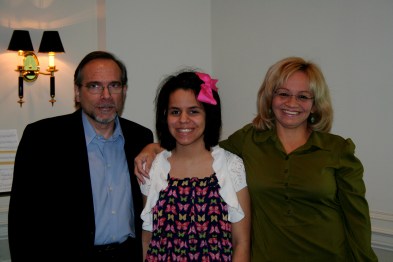
On November 16, My wife, Grace, and I presented our findings regarding Autism and Music. This concluded a four month investigation of the effect if any clarinet lessons would
have on my daughter Emmanuela, who has been diagnosed with highly functional autism, and me as her father, conductor and clarinet instructor. I kept a journal of each lesson and Emmanuel also kept a journal.
My wife presented a case for music and its regenerative powers of certain portions of the brain. “Mano” explained how difficult it was to play the clarinet but expressed her happiness of finally being accepted into a group, her school Band with a grade of a “B!” She is very proud of her accomplishments as we are.
It was difficult to hold back the tears when we talked further about Mano’s many challenges in middle school, socially (she is often a target of bullying) and scholastically with English intense subjects like history.
As a grand finale, Mano and I performed two duets from her Band book. Mano performed very well and there wasn’t a dry eye in the room. This was a special experience for me as a parent and my ties with my daughter have never been stronger.
It was a family affair of collaborating with Grace, a counselor, and myself, a musician. This was Grace’s idea that was first suggested during the summer. It was a great journey that still has not ended.
My take on A Late Quartet … No passion, no reason to play
In STEPHEN HOLDEN’s New York Sunday Times (Nov 4, 2012) music review of the film, A Late Quartet, he states the credo of any musician worth being called a true musician: The film “has an important point to make about classical music. For the musicians who play it, especially intimate chamber works in which the group members have to think, feel and breath as one, their instruments are vehicles for conveying strong emotion. Without passion, a performance, no matter how impeccable, is just a technical feat.”
Whether it is chamber music or a Mahler symphony, if there is no passion, no commitment, no personal understanding, no love, then there is no reason to be playing.
Autism Spectrum: Emotional Regulation through Clarinet Lessons at 2012 VASC VCA Convention
Grace Kolman, Doctoral Student at James Madison University and Maestro Barry Kolman, currently Professor of Music, Washington & Lee University presented “Autism Spectrum: Emotional Regulation through Clarinet Lessons” at the 2012 Virginia Counselors Association Annual Convention. The annual convention was held at the Fredericksburg Expo & Conference Center on November 15 -17, 2012.
The presenters explored the significant emotional benefits of teaching music to adolescents with Autism. One particular case was assessed with a live clarinet performance. The instructors and students then reported on how the experience changed their lives.