Post Script to Marvin: We’ll continue playing HIS song

In this season of political rancor and of foreign governments attacking their own citizens, it’s a good time for all of us to step back  and take a deep breath and seek out something that will whisk us away, at least for a little while.

Marvin Hamlisch–The Man and His Music— is what is right with life. His melodies will live on even if the man himself is gone. I was appalled regarding how little time was spent by our news markets in commemorating this man’s great contribution to making our lives that much better; he was a real Mensch.

I was one of the fortunate fans who met Mr. Hamlisch in person. Several years ago, he presented a solo performance at a neighborhood venue and I was lucky enough to be in the audience. It was just an empty stage, a grand piano, a hand mike, and Hamlisch. He played his music, played other people’s music, bantered back and forth with the capacity audience, and showed his relaxed personable side while performing flawlessly on the piano. His arrangements from film and theater were full and romantic, but music of the stage in particular was certainly his forte.

About halfway through the program, he stopped suddenly, and blurted out, “Wait a minute, I hear a certain song!” Then after two piano chords, two local college students literally flew out of the wings of the stage, crossed downstage and much to the surprise and joy to all of us, began singing Hamlisch’s own award-winning They’re Playing Our Song.” The improvised choreograph was professional and the crowd loved it. I knew these two musical theater majors and after the show I went backstage to congratulate them and to meet Mr. Hamlisch. He truly was “the real thing” on AND off the stage; sincere, funny, and charming. A great night for me.

I mourn his passing; we have lost one of the Greats. He had so much more to show us.

What? Nikitin Insists Tattoo is not what we all think it really is…

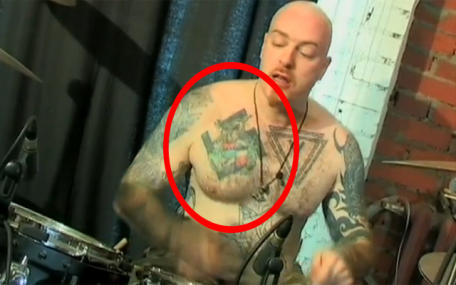
Well if it walks like a duck and quacks like a duck! The Wall Street Journal (among other press and media outlets via AP) reported today that the Russian bass-baritone Evgeny Nikitin withdrew from the Bayreuth Wagner Festival last month following the appearance of a tattoo during a program broadcast on German television.

It appeared to be a swastika tattoo partly covered by another symbol.  Now he says the image was not a swastika.

In my opinion, the tattoo should never have been seen and he was insensitive to let it be seen or even having it to begin with. But look at the people who pressured him to walk.

Wagner, who died in 1883, wrote anti-Semitic essays and was the favorite composer of many Nazi leaders. The Bayreuth Festival, which he established, is run by great granddaughters Katharina Wagner and Eva Wagner-Pasquier. Ugly hypocrisy in our profession. All parties are guilty on this one.

By the way, Nikitin remains scheduled to sing in Wagner’s “Parsifal” that opens at the Met on Feb. 15 next year. No tears shed.

Thoughts on Conducting

Nonverbal communication…is that what conducting is all about? Or are we just the composer’s advocate as Leinsdorf professes in his landmark book? As someone who has been on both sides of the podium, the conductor’s role is more complicated. You ARE the music, you ARE the inspiration behind the music; and you ARE the teacher whether the conductor is in front of a student orchestra or a group of seasoned professional musicians.

A great conductor should be of course a great musician but he/she also part problem solver, part therapist, part inspirational leader, part ballet dancer, part teacher and part fund raiser…always keeping this primary goal in mind; to bring out the best in your players, to give your audience a special experience and a good reason to leave the security of their homes to come out to hear live music.

Live music. Whether a listener or a player, there is something special in hearing, feeling, sensing music. Can’t you just feel Beethoven’s struggle in his Third Symphony. Who is the hero here? Napoleon or Beethoven for choosing the road to live and to not to give up.  Or the struggle of Shostakovich or Tchaikovsky problematic life hiding his homosexuality. Can we figure all this out by just hearing the music? By watching the conductor? It depends on who is conducting.

What an awesome responsibility to be a conductor. When the opera begins, the musical begins; it’s all in the hands of the conductor.

My philosophy about conducting? Know thy art and know it well. Know your orchestra; know the musicians by name; look at them and understand their point of view. Be fair and honest. Be demanding but never forget that those are people in front of you are not just a sea of strings or wind players but PEOPLE. Have an vision artistic vision for the orchestra; where should we be in 5 years, 10 years? And most importantly, share your vision with everyone and LISTEN to your players, your Board, your audience.

Today’s music director looks much different than a generation ago. The days of conductors flying in for a few rehearsals, a couple of handshakes, perform the concert and then fly home on the next flight out of town. The music director is the public face of the Orchestra. He/she should be an integral part of the cultural tapestry of the community. The Maestro needs to be seen shopping at the local mall, attending other concerts or theatrical production, or just seen walking around town with his family.

I recently met somebody face to face who told me that that she has recently become a loyal concertgoer and this was the first time she has seen me not in tails and not from behind. You just don’t know what an positive impact a music director has when he steps off the podium and just becomes part of the community, meeting folks one on one.

As part of the Orchestra team, music directors need to be fully immersed and involved in fundraising and making certain the Orchestra is in good financial health. The seats must be filled and the musicians must be paid a fair and equitable wage. Through innovative and thoughtful programming, the underserved population, the nontraditional concertgoer, and young people must all feel welcome to the concert hall. Young people in particular should not be intimidated by all those people on stage dressed in black. With the assistance of the artistic team, the conductor should provide opportunities in and outside the concert hall for these constituencies to hear and see their orchestra; their friends and neighbors who have this special talent to create something so universally beautiful. The orchestra belongs to people of all ages and from all walks of life. It’s a challenge but it’s a challenge I have embraced here in Virginia and I am proud to say my audience is a diverse as my concerts.

As a conductor who has travelled a great deal, I always learn something new with each rehearsal and performance I conduct. Each experience is unique and I love each experience. I am happiest when I am on the podium, creating something from black notes on a page with people who share the same love I have for this very special art.

Tanglewood’s 75th Celebrated in Style

The granddaddy of summer festivals, the most highly regarded summer show, perhaps of the world, is having its 75th Birthday.

Some of their programs, featuring many of our musical stars, are performing programs from its initial season in 1937 which
was conducted by Koussevitzky. Tanglewood is the world’s pre-eminent festival and its alumni includes the Who’s Who of classical music.

What comes to mind after reading all the press about this celebration is my own personal trip to the Cleveland Symphony summer home, Blossom Festival, a wooded area right outside of Cleveland, not nearly as beautiful and enchanting as Tanglewood in Massachusetts. I travelled there for the sole reason of watching how the Big Guys conduct Tchaikovsky’s Fourth Symphony, a barn-burner of a piece which I was going to use an audition piece in a few weeks. The Cleveland Orchestra, was hosting a young guest conductor, a student of Franz Welser-Möst, their music director. Musical nepotism abounds in the guest conducting business. In the last SYMPHONY magazine there was an article entitled “Family Reunion”! Shameless nepotism. Everyone knows it’s there and nobody seems to care that it exists.

At that concert in Cuyahoga Falls, Ohio I witnessed so clearly the tail (the Orchestra) wagging the dog (the conductor). The star of the evening was a soloist, young in stature but enormous in presence and talent, playing Tchaikovsky’s Violin Concerto, in spite of the flailings of the young inexperienced conductor. In thhe second half, the CSO performed the 4th; no one looked up to watch the conductor; I couldn’t look up either. I travelled hours to see this symphony performed so I could carefully watch and dissect how to perform it with elan, precision, and power. The guest conducting showed such a lack understanding of the work and of the composer. My seat was ten rows from the Orchestra. I was so disappointed for some many reasons.

With so many well-seasoned, experienced American conductors available, why do orchestras tend to choose these days 30-somethings with no or very little experience? These conductors win a competition or two and they become instant successes. Even one of the winners of the esteemed Malko Competition admitted that he never conducted a professional orchestra in his life until the competition in Denmark.

So what’s your problem with young conductors?” I have been asked. “After all Leonard Bernstein, at the tender age of 25, shot into stardom by stepping in for Bruno Walter, to conduct a performance with the New York Philharmonic, without a rehearsal.” To which I answer, paraphrasing a great comeback line,” I met Leonard Bernstein. I watched Leonard Bernstein conduct. You’re no Leonard Bernstein.”