Learn Music; Now In Spanish. Book Launch in New York City

face_out_november_english-01

New Book by W&L’s Kolman Explores History of American Wind Music

Posted on October 31, 2013 by Sarah Tschiggfrie

"The Origins and Early History of American Wind Music: Instrument Makers, Composers, Instructional Methods and Ensemble Performance"Barry Kolman’s new book, “The Origins and Early History of American Wind Music: Instrument Makers, Composers, Instructional Methods and Ensemble Performance,” (Edwin Mellen Press, Sept. 2013) is the first volume to examine the earliest musical beginnings of the tradition of community bands in America during the half century following the American Revolution.

Kolman has already been awarded the Adele Mellen Prize for his book’s distinguished contribution to scholarship in the field of American Music History. He is professor of music at Washington and Lee University, conducts the University-Shenandoah Symphony Orchestra (USSO) and is a frequent guest conductor of orchestras around the world.

Kolman noted that orchestra conductors study the history of music, such as from the baroque and romantic eras, when they prepare a piece to conduct and that he hopes that band conductors will now use his book to understand the origins of the music they are conducting. “As a clarinet player I’m very interested in wind music — for clarinet, flute and wind ensemble — and since band music is an important part of American culture, I wanted to find out how it took off and evolved into what it is now,” he said. “Some of this music is still performed now and then, and I would like readers to appreciate where this music came from and not take it for granted.”

According to Kolman, most existing studies of the history of music start around the 19th century and the Civil War but nobody has researched what happened to the music and the instruments after the Revolution, when the English musical influence was still dominant.

Music was a very popular form of entertainment before the Revolution and relatives, friends and neighbors gathered in homes to play musical instruments at evening musical soirées.  After the Revolution, interest in these soirées grew as a group of musicians, mostly from New England, began to provide instruction and music in the form of tutors — method books that gave diagrams, fingering charts, scales and exercises, as well as musical compositions in the back of the books.

Cheap and plentiful, the tutors were sold in many places, including tobacco stores and on newspaper stands. People knew all the popular marches by ear already and now, for the first time, they learned to play them in small instrumental ensembles that marked the beginning of a long tradition of community bands in America.

These tutors were published by composers whom Kolman described as “the first generation of American composers who wanted to write for a new America, defining an American style, sound and cultural identity.”

There were many authors of these tutors and in his book Kolman focuses on seven of the more prolific and influential composers: Oliver Shaw, Joseph Herrick, Ezekiel Goodale, William Whiteley, Henry Moore and Samuel Holyoke, who was probably the most important of these pioneers. The book includes a history of each composer.

These composers published both original marches and arrangements of marches for various combinations of instruments and for duets, trios and octets. Because they composed for whatever instruments they knew people in the community possessed, including woodwinds, brasses, strings, percussion and piano, Kolman said this resulted in some unusual combinations, including one piece for clarinet, flute, trumpet and a snare drum.

Kolman said that it took him 35 years to write the book, which began as his doctoral thesis, and he encountered many difficulties in tracking down primary source material. “I wanted to find the major composers of this type of music and hold what they wrote in my hands,” he said. “But it was a really tough challenge to find music that was written 200 years ago. I thought it had been destroyed, but I actually found the original copies signed by the composers through a lot of legwork going to libraries and was able to include copies of those scores in the book.”

Kolman also looked for the instruments of the period or at least pictures or descriptions of them. The book describes each instrument in detail, including original fingering charts and insight into the instructional methods at the time.

“I looked for anything I could get my hands on to figure out what instruments they were playing. For example, what did a bassoon look like? And one instrument, the serpent — a bass instrument with a strange configuration — is rarely played today,” he added.

Kolman also found the original tutors. “They were written in old fashioned English and the advice that some of these composers gave was a little humorous by today’s standards. A lot of things have changed in 200 years, probably because the instruments became better built, and we don’t have to do some of the funky things that the early teachers made their students do,” he said.

Kolman received his B.Mus. in music education from the Crane School of Music, his M.Mus. in clarinet performance from Illinois State University and his Doctor of Arts degree in conducting from the University of Northern Colorado where he was awarded the Dean’s Citation for Excellence for his graduate research.

“The Origins and Early History of American Wind Music: Instrument Makers, Composers, Instructional Methods and Ensemble Performance,” is available at the University Store and through its website at http://bookstore.wlu.edu.

W&L’s Kolman Publishes Spanish Edition on How to Read, Write Music

Posted on October 31, 2013 by Sarah Tschiggfrie

"El Languaje de la Música, al Descubierto"Barry Kolman, professor of music at Washington and Lee University, has published a Spanish language version of his acclaimed book “The Language of Music Revealed” (Universal Publishers, 2012).

According to Kolman, “El Languaje de la Música, al Descubierto”(Editorial Seleer, Spain, 2013) is the first book published in Spanish on the fundamentals of how to read and write music.

Critics have praised “The Language of Music Revealed” for “moving musical theory and practical application into a new and engaging realm,” and hundreds of teachers have adopted the book as their standard student text.

“Unlike most music theory books, Kolman has worked hard to ensure that the book is fun, engaging and develops a deeper understanding and appreciation of the subject,” wrote one critic.

Kolman hopes the success of the English version will be repeated in the Hispanic community with the Spanish language edition.

“This was a labor love,” said Kolman. “I was appalled that there were no books written in Spanish on music fundamentals for the average person. Spanish universities told me that they translated whatever books they found into Spanish and also used a lot of British books. But there were no books written in Spanish.”

Like the English version, the book includes graphics, a cartoon character and jokes to guide the reader through music theory. “The jokes didn’t quite translate into Spanish,” said Kolman, “so the translator and I made up jokes that would work in Spanish.”

He credited Washington and Lee University for providing the funds to hire the translator, who needed to know about music since musical terms don’t translate verbatim.

Kolman introduced the book and played clarinet to a Hispanic audience at the Virginia Hispanic Chamber of Commerce’s 10th Annual Hispanic Gala in October. He has also been invited to work with various schools in Chicago, Ill., talking about the book and giving mini lessons on how to read music.

Kolman conducts the University-Shenandoah Symphony Orchestra (USSO), along with teaching music fundamentals, introduction to music, applied clarinet, and conducting. He is a frequent guest conductor of orchestras around the world.

He received his B.Mus. in music education from the Crane School of Music, his M. Mus. in clarinet performance from Illinois State University and his Doctor of Arts degree in conducting from the University of Northern Colorado.

“El Languaje de la Música, al Descubierto” is available at bookstores and online.

NEW The Language of Music Revealed: A Real Easy Way for Anyone to Learn to Read IN SPANISH!

NEW The Language of Music Revealed: A Real Easy Way for Anyone to Learn to Read IN SPANISH! Finally, a music fundamentals book in Spanish for the non-musician: first of its kind, now available in the US.

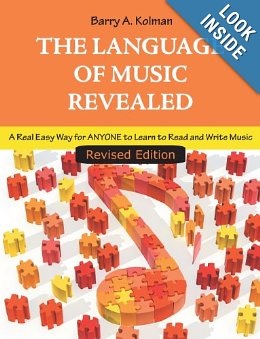
EL LENGUAJE DE LA MÚSICA, AL DESCUBIERTO: Un Método Tan Fácil Que Cualquier Persona Es Capaz De Aprender A Leer Y Escribir Música.AbeBooks-logoamazon.com


The Language of Music Revealed: Reviewed!

51rFPXC8KPL__SX260_PJlook-inside-v2,TopRight,1,0_SH20_

Barry A. Kolman

http://www.amazon.com/Language-Music-Revealed-Anyone-Learn/dp/1612331289/ref=sr_1_1?s=books&ie=UTF8&qid=1379277094&sr=1-1&keywords=barry+kolman

“GOOD JOB, Barry! I didn’t have time to read every word on every page, but going through the Table of Contents, Introduction and Chapter 1 Toolbox, it is obvious that this is a textbook that has been long awaited for the music lovers who want to take the first step towards becoming perceptive music consumers. The cool icons and straight-forward language (you grew up in Brooklyn, right?) help connect the abstract terminology and concepts with familiar ideas. I will lend the book to our high school AP Music Theory teacher and then to the 3 middle school music teachers (the choral and two instrumental teachers all teach General Music). I cannot promise that I can request a class order of this textbook, but I will certainly let you know if will plan on purchasing more copies.

Joseph Rutkowski, Instrumental Director at John L. Miller Great Neck North HS since 1991”

“I like the book a lot – it is a concise, yet comprehensive explanation of everything the average person could want to know about music theory. User friendly – A great resource!

~Dr. Janine Robinson, Choral Director/AP Music Theory Instructor at the John L. Miller Great Neck North HS since 2012, Choral Director/General Music Instructor at the JF Kennedy Elementary School in Great Neck since 1995”

MORE:

http://www.goodreads.com/book/show/15954556-the-language-of-music-revealed?from_search=true#other_reviews

Drumming On The Inside

More than a thousand events at this year’s Make Music New York, the daylong, citywide festival celebrating the summer solstice, were open to the public. But one concert took place behind closed doors — as well as iron gates and barbed wire. “Rhythm on Rikers” may be the least publicly visible component of this annual event, but it is also the most socially ambitious, bringing the joyful percussion music of West Africa into the prison on Rikers Island.

Eight inmates participated in a 10-week program of weekly lessons in music theory and drumming. On Friday they performed two concerts for fellow prisoners with their instructors, the percussionists Amy Garapic, Malavika Godbole and Matt Evans, in the gym of the Eric M. Taylor Center, one of the island’s jails.

The drum maker Remo donated a collection of African percussion instruments including djembes, djun djuns, a shekere and a gankogui bell. It was on this double iron bell that Mr. Evans tapped out the rhythm of the first song, “Funga Alafia.” Seated in a semicircle, the performers took turns pounding out solos, which the rest of the group then picked up. Attempts to draw the audience into the call-and-response chanting initially produced only a few embarrassed grins.

But the performers beamed and shouted encouragement to one another during a bembe, a complex West African rhythm that is also common in Afro-Cuban music, and a fully improvised number that culminated in a polyrhythmic whirlwind. During an infectiously cheerful kpanlogo, which featured a number of impressive solos, at least a dozen inmates in the audience joined in clapping, rocking and stomping their feet. CORINNA da FONSECA-WOLLHEIM